
Winged ants and flying termites can be confused. Compare the waist, antennae and relative wing sizes on an intact insect, not just loose wings. Photograph the insect and the location. An insect near a light does not by itself prove termites are nesting in your home.
A group of winged insects beside a window can lead to an urgent search for termite treatment. Identification and context should come first. This checklist concerns the swarm you can see; the general termite guide covers the broader signs and treatment questions.
Three features to compare
The University of Minnesota Extension ant guide compares winged ants with termites using these features. This is a general comparison, not an identification of Singapore species from one photograph.
| Feature | Winged ant | Winged termite |
|---|---|---|
| Waist | A visibly pinched waist | A broad waist without the same pinch |
| Antennae | Elbowed or bent | Straighter, bead-like antennae |
| Wings | Front wings longer than hind wings | Two pairs of broadly similar length |
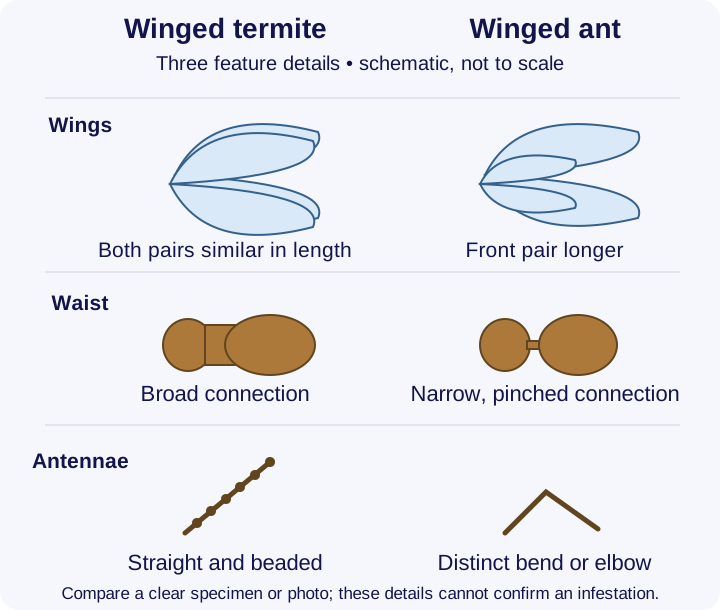
Damaged wings, folded bodies and a phone photo taken from far away can hide these differences. Do not decide from colour or the word “flying” alone. Where an insect cannot be identified confidently, ask for assessment rather than treating the table as a test you have passed.
Record where the insects actually appeared
- First observed point: outside a window, already inside a room, or apparently emerging from a specific gap.
- Pattern: one event or repeated sightings, with dates and approximate numbers.
- Condition: intact insects, loose wings, or both. Photograph them separately.
- Other evidence: possible mud-like tracks, damaged timber or material beneath furniture, without pulling it apart.
“At the window” and “emerging from this timber joint” are different observations. Neither establishes the full source or damage extent without further assessment. Note what you saw rather than writing “the whole wall is infested”.
A simple swarm-to-inspection handover
- Take a close image and a wider image showing the location. Do not climb or open electrical fittings to do so.
- Keep children and pets away from loose insects or material while you record it.
- Send the record and explain whether the area is about to be covered, repaired or removed.
- Ask what access is needed and whether the insect can be identified from the available evidence.
- Request a written explanation of any recommended treatment, its limits and any follow-up.
A swarm is not a reason to choose a soil treatment, baiting system or surface spray without an assessment. Four's termite service page explains why the proposed approach depends on the findings and access.
What if there is dust beneath wooden furniture too?
Record that material separately. It may require a different identification task from the flying insects. The timber dust and pellets guide explains what to document. Do not assume that two signs found in the same room have the same cause.
For a renovation, use the inspection and handover checklist before concealing the relevant area. Structural safety and repair decisions belong with the appropriate building professional.
Sources and scope
These references support general identification or household decisions. They do not establish the cause at your property, prescribe a Singapore pesticide product, or document a Four Solutions job.
Flying Termites or Winged Ants FAQs
Do flying termites by a window prove my home is infested?
No. Record the insects and where they appeared. A sighting alone does not establish their source, the presence of a colony in the home or the extent of damage.
Can I identify the insect from loose wings alone?
Loose wings can be useful evidence, but they do not show the waist or antennae. If possible, photograph an intact insect as well and ask for identification.
Should I cover a gap before an inspection?
Tell the assessor about the gap and any planned repair or renovation before covering the evidence. Ask what access is needed; do not delay an urgent building-safety repair on the basis of this guide.