
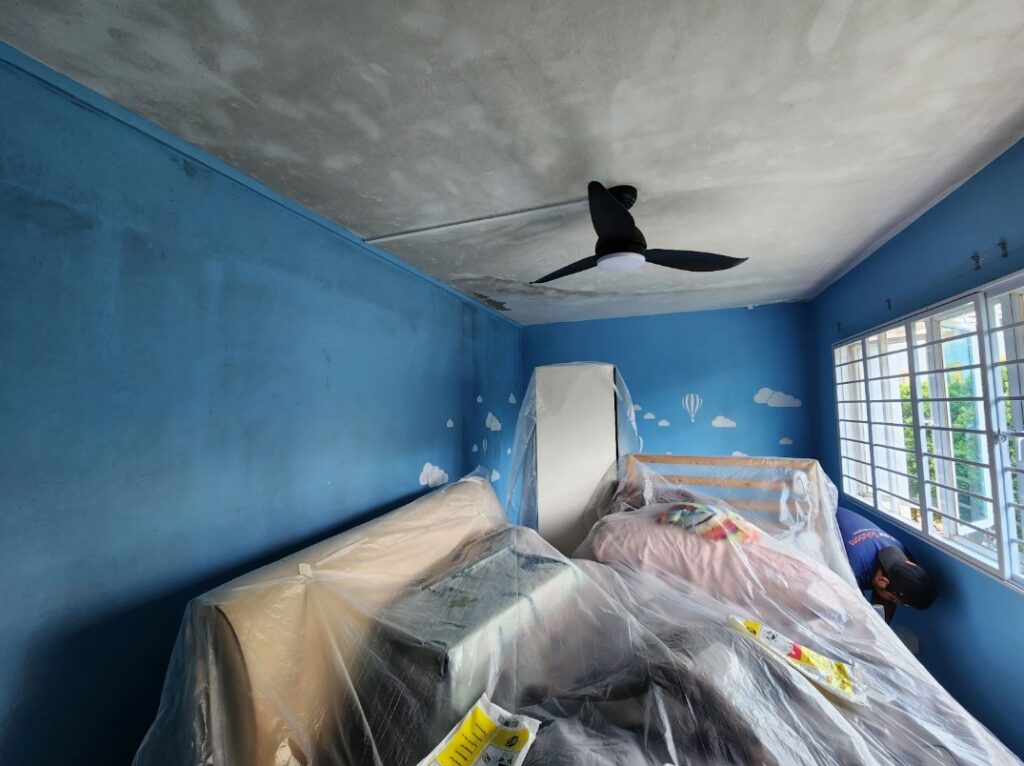
Anti-mould paint is a coating that its maker says helps resist mould on the painted surface. It does not remove growth that is already there, dry a wet wall or stop a leak. Treat paint as the last of five separate steps: assess, correct the moisture, clean, dry, then coat if the surface is suitable.
Most people compare paint by colour, finish and price. In a humid climate the more useful question is what the paint is being asked to do. A mould problem is usually a moisture problem first, and a coating only helps once the surface underneath has been dealt with. This guide compares the two kinds of paint, sets out the order of work, and ends with a checklist you can use when you prepare for a quotation.
Regular paint and anti-mould paint compared
Regular paint
A decorative finish. It is not sold on the basis of resisting mould, and painting over mould or a damp surface hides the problem instead of dealing with it.
Anti-mould paint
A coating whose maker states it is formulated to resist mould growth on the painted film. Claims, suitable surfaces and preparation differ by product, so the product data sheet is the document to read.
Neither one
Removes mould already growing, dries a wet substrate, repairs a leak, stops condensation or removes a musty smell that comes from a damp source.
Because the difference lies in what the product is designed for rather than how it looks, this guide does not rank brands. It uses one manufacturer's data sheet as a worked example, and it names the paint Four Solutions uses by default. Where a quotation names a coating, ask for its data sheet and any written terms instead of relying on a general promise.
What anti mould paint is, and what the label words mean
Anti mould paint is paint with an added biocide or fungicide, an ingredient meant to stop mould growing on the dried paint film. The UK Health and Safety Executive's list of biocide product types calls these additives film preservatives, used to protect "the initial properties of the surface" of paints and other coatings. The US EPA treats a claim that paint stops mildew "on the surface of a dried paint film" as a claim about protecting the paint itself.
The words on the tin:
- Anti mould, anti fungal, mould resistant. Makers use these words for a paint film that resists growth. Nippon Paint Singapore lists both "mould resistant" and "fungus resistant" on one interior wall paint. Read the data sheet for what is covered.
- Anti fungus wash. A separate liquid for the bare surface before painting, to deal with existing growth. It is not a paint.
- Biocide or fungicide additive. The ingredient that gives the film its resistance.
None of these labels means the paint removes existing mould, dries a damp wall or stops a leak.
Five steps, kept separate
Even when treatment and painting are quoted together, ask what each stage includes. Use these five questions to compare the proposed work.
1. Assess what you have
Note where the mould is, how far it spreads and what the surface is: painted ceiling, wall, timber, silicone or grout. Look for signs that the material is wet and not only stained, such as bubbling or flaking paint, a soft or powdery surface, a damp patch that is cool to touch or a musty smell that stays after cleaning. Photograph a wide shot and a close-up, and record when it first appeared.
2. Correct the moisture
Mould needs moisture. The US EPA's building-moisture guidance lists condensation and leaks among common causes, and judges water damage by its signs, not by appearance alone. Work out whether the source is a leak, seepage, condensation on a cold surface or a room that stays damp after use. Four Solutions' mould page says any separate repair needed to stop moisture should be identified before you agree to treatment. This guide does not suggest that a paint job, or a mould quotation, covers plumbing or waterproofing repair.
3. Clean or remove the growth
Existing growth has to be dealt with before anything goes on top. The EPA's cleanup guidance says to fix the moisture problem and to clean and dry the area before repainting or caulking. It also notes that very porous materials may not clean up fully. If you use a household cleaner yourself, follow the label and never mix cleaning chemicals, as the CDC advises. Four Solutions' published process describes mould removal from the affected surface as its own step ahead of any coating.
4. Let the surface dry
A coat applied over a surface that is still damp can fail. Ask the applicator or check the product data sheet for the drying conditions that apply. Drying conditions depend on the material, the product and the room.
5. Coat only where it is suitable
Four Solutions' mould page says that, where suitable, mould treatment can include odourless anti-mould painting to help reduce future growth. Whether a coating suits your surface is decided after assessment. A coating is not suitable for every surface: grout, silicone and items in a wardrobe need different handling and are covered in the bathroom mould guide and the wardrobe mould guide.
How to use anti mould paint on a wall or ceiling
Paint is the last step. This order follows the US EPA's cleanup guidance and the data sheet for Nippon Paint Singapore's anti mould ceiling paint. Your product's data sheet sets the details.
- Stop the water. The EPA says to fix plumbing leaks and other water problems as soon as possible.
- Remove the mould. The EPA says not to paint mouldy surfaces: clean up the mould and dry the surface first. The data sheet asks for mouldy areas to be washed and treated with an anti fungus solution.
- Let it dry. No water may remain on the surface, and the data sheet sets a maximum moisture reading.
- Prepare. Remove loose or peeling paint, wipe off dust and grease, and fill hairline cracks.
- Seal, then paint. For masonry: one coat of sealer, then two coats of paint, with a minimum wait between coats.
- Ventilate. Keep the room ventilated while the paint dries, and check the data sheet's temperature and humidity limits.
On a ceiling
The same order applies overhead. Some anti mould paints are made for ceilings: Nippon Paint Singapore recommends its anti mould ceiling paint for damp areas such as kitchens, bathrooms and areas around air conditioners. Before you start, look for a stain that spreads from one area or water marks running from the ceiling down the wall, which HDB's maintenance guide names as a sign of a ceiling leak. If the plaster crumbles when you scrape it, stop. The data sheet asks for a surface that is clean, dry and stable, and a crumbling ceiling is not stable.
When a coating makes sense, and when it does not
- It can make sense after the growth has been removed, the surface is dry and the cause of the moisture has been identified and addressed, particularly on a ceiling or wall in a room that is humid by nature, such as a bathroom or kitchen.
- It does not make sense yet while there is an active leak, a wall that is still wet, paint that is peeling away from a damp surface or growth that has not been removed.
- It may be the wrong tool for a recurring problem that is really condensation from a cold surface or poor air movement. Those are conditions to fix, and a coat of paint will not change them.
Signs the paint will not hold
- An active leak. Paint does not stop water. Fix the leak and let the area dry before any coating goes on.
- Damp plaster. If the wall or ceiling still feels cool and damp, or a moisture meter shows it is wet, it is not ready for paint.
- Peeling, bubbling or powdery paint. The US EPA lists peeling paint among the signs of a water leak, and warns that paint applied over mouldy surfaces is likely to peel. Loose paint has to come off first, and Nippon's data sheet recommends a separate treatment for a powdery surface before the paint system. Damaged plaster may need repair. Our ceiling mould page explains how a ceiling is assessed.
- Mould that returns in the same spot. Mould can return after it has been cleaned or painted over when the cause has not been dealt with. A different paint will not change that.
What to expect from any anti-mould coating
No coating makes a surface permanently immune, and no product on its own protects a room that stays wet. How long a finish performs depends on the product, how well the surface was prepared and how dry the room is kept afterwards. Four Solutions' mould page says warranty options depend on the treatment scope and site conditions, so ask for eligibility and exclusions for your job in writing before work starts. A protective coating does not establish indoor air quality or address a person's symptoms.
Which paint Four Solutions uses
Where anti mould painting is part of a Four Solutions job, our mould remediation terms name the default: a Nippon odourless anti mould paint in white. Other brands, such as GUSH or Dulux, are available on request, and extra charges may apply. Colour tinting is possible but may cost more.
Points from the same terms worth knowing before you book:
- A sealer is not included by default. It is charged if you ask for it or the surface needs it.
- The paint goes onto the existing surface and will not correct imperfections underneath. Minor hairline cracks and nail holes are patched as standard preparation, and extensive replastering is charged separately.
- Where suitable, painting is done after mould removal. It does not replace it.
Ask for the exact product name and its data sheet in your quotation.
Preparation and quotation checklist
Before you ask for a quote, gather:
- Photos: one wide, one close, and one of any peeling, bubbling or stained paint.
- The room, the surface and the approximate area affected.
- When it first appeared, how often it returns and whether the area has been repainted before.
- Any leak, seepage, condensation or aircon issue you have noticed nearby.
- Whether you own or rent the home, since a landlord or the managing corporation may need to agree to repainting or colour changes.
Then ask what the quotation states for each of these:
- Which of the five steps are included, and which are left to you or another contractor.
- Whether the moisture source has been identified, and who deals with it.
- Whether the price covers removal, a protective coating, repainting of the whole wall or ceiling, or only the patch, and whether odour treatment is included.
- What the surface must be like before coating, and how drying is checked.
- How furniture and nearby areas are protected, and whether you need to move anything.
- The warranty eligibility, exclusions and conditions for this treatment.
- The current inspection scope and fee, if there is one, before you book.
Four Solutions' mould removal service sets out its published process and cost factors, and the quotation is where those are confirmed for your property. If you would like a first look before deciding, you can send your photos on WhatsApp.
Sources: the US EPA on mould cleanup in your home and on moisture and mould in buildings, and the CDC on mould. These are United States guidance and general principles, not Singapore regulation or an assessment of your property. Guidance checked 8 October 2026.
Paint terms and preparation: Nippon Paint Singapore's product pages for its anti mould ceiling paint, its anti fungus solution and its interior wall paint and the ceiling paint's technical data sheet, the US EPA's notice on treated articles and brief guide to mould and moisture, HDB's maintenance guide, and the UK Health and Safety Executive's list of biocide product types. Checked 10 October 2026.
Frequently asked questions
Does anti-mould paint get rid of mould?
No. Anti-mould paint is intended to help resist growth on a treated surface, but it does not remove existing mould or fix the moisture causing it. The mould has to be removed and the moisture dealt with first, then a coating can protect the finished surface where it is suitable.
How long does anti-mould paint last?
There is no fixed period. It depends on the product, how well the surface was prepared and dried, and whether the moisture source was fixed. Ask for the product data sheet and any written warranty terms. This is separate from the anti mould protective coating Four Solutions applies after mould removal, which its service pages describe as lasting about 3 to 6 months.
How does anti-mould paint work?
Makers add ingredients intended to resist mould growth on the painted film. It is a protective layer and not a cure, so it is considered after the mould is removed and the area is fully dry.
Is anti-mould paint worth it?
It can be a sensible last step after the mould is removed, the surface is dry and the moisture cause is dealt with. Over live mould or a damp wall it only hides the problem.
Can I paint over mould with anti-mould paint?
No. Painted-over mould is still there. Remove the growth, deal with the moisture and let the surface dry before any coating goes on.
How do I use anti mould paint?
Fix the moisture source, remove the mould and let the surface dry fully. Scrape off loose paint and fill small cracks, then apply the sealer and the number of coats the product's data sheet recommends, with the room ventilated. Do not paint over live mould or a damp wall.
What is the difference between anti fungal paint and mould resistant paint?
On a paint label, both describe a film that resists mould growth, and some makers list both words on the same product. The useful difference is between a paint and a wash. An anti fungus wash goes on the bare surface before painting to deal with existing growth. Anti mould or mould resistant paint protects the finished film. Check the data sheet for what each product covers.
Does anti mould paint work on a damp or previously mouldy wall?
Not on a damp wall. The US EPA warns that paint applied over mouldy surfaces is likely to peel, and Nippon Paint's data sheet asks for a surface that is clean, dry and stable. On a wall that had mould, it can help once the growth is removed, the moisture source is fixed and the surface has dried. If mould keeps returning, the moisture has not been dealt with.
Which anti mould paint does Four Solutions use?
Our mould remediation terms name a Nippon odourless anti mould paint in white as the default. Other brands such as GUSH or Dulux are available on request, and extra charges may apply. Ask for the product name and its data sheet in your quotation.
What should a mould quotation say about painting?
It should state whether removal, a protective coating, repainting and odour treatment are included, what the surface must be like before coating, and the warranty eligibility and exclusions for your job.